


.svg)



















Most AI systems that handle conversations still follow a straightforward pattern: recognize speech, detect intent, generate a response. That works for the simplest scenarios, but it breaks down the moment a conversation requires context, flexibility, and real-time decision-making.
This is where cognitive architecture comes in — an approach that treats conversation not as a sequence of commands, but as a cognitive process, complete with goals, memory, reasoning, and action.
In this article, we'll walk through what cognitive architecture actually looks like in practice, what components make it up, and why it's the key factor in whether conversational systems perform reliably in real-world conditions.
What is cognitive architecture?
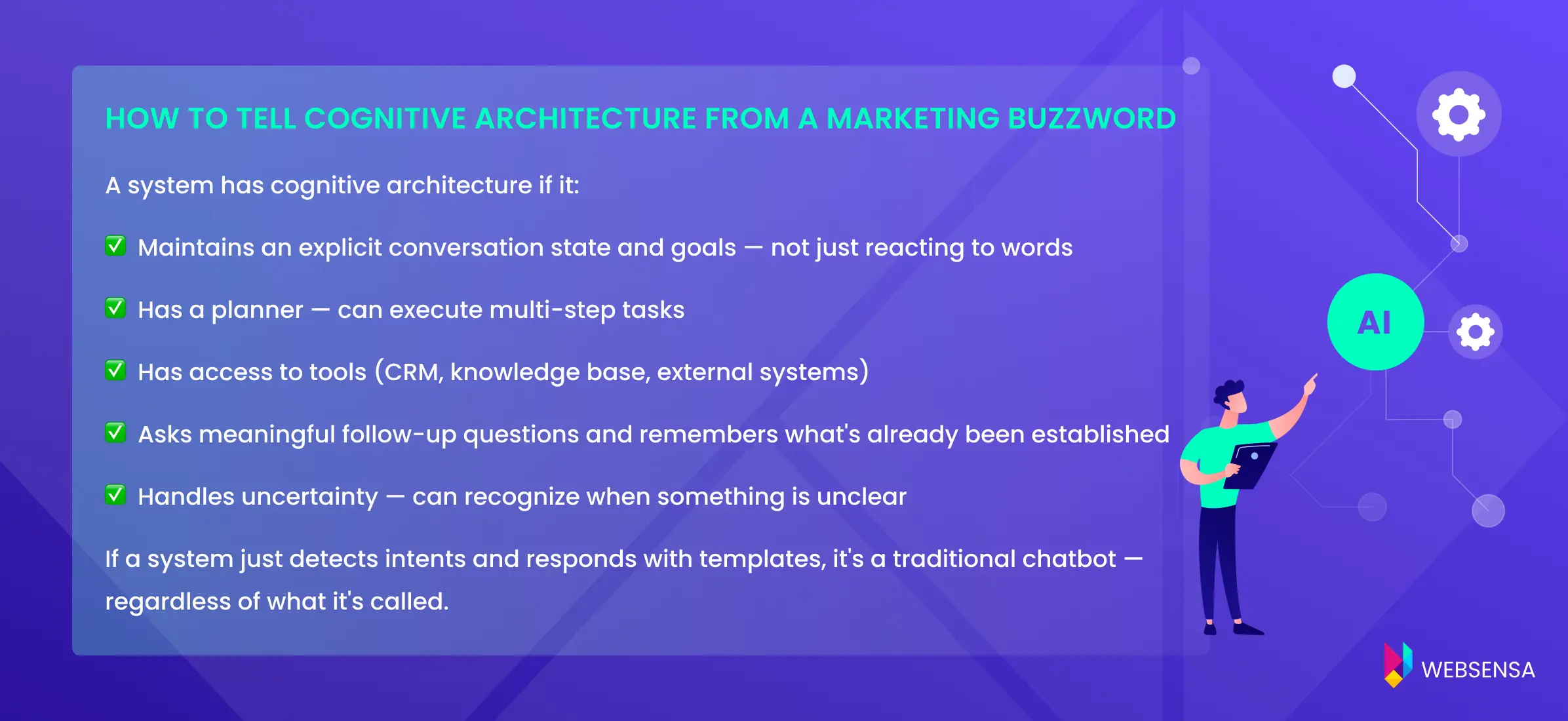
Cognitive architecture describes how an AI system processes information and makes decisions during an interaction with a user.
Rather than relying on a single, linear pipeline, cognitive architecture assumes a system built from several cooperating layers. Each layer has a specific role, and their combined operation is what enables coherent, goal-driven conversation.
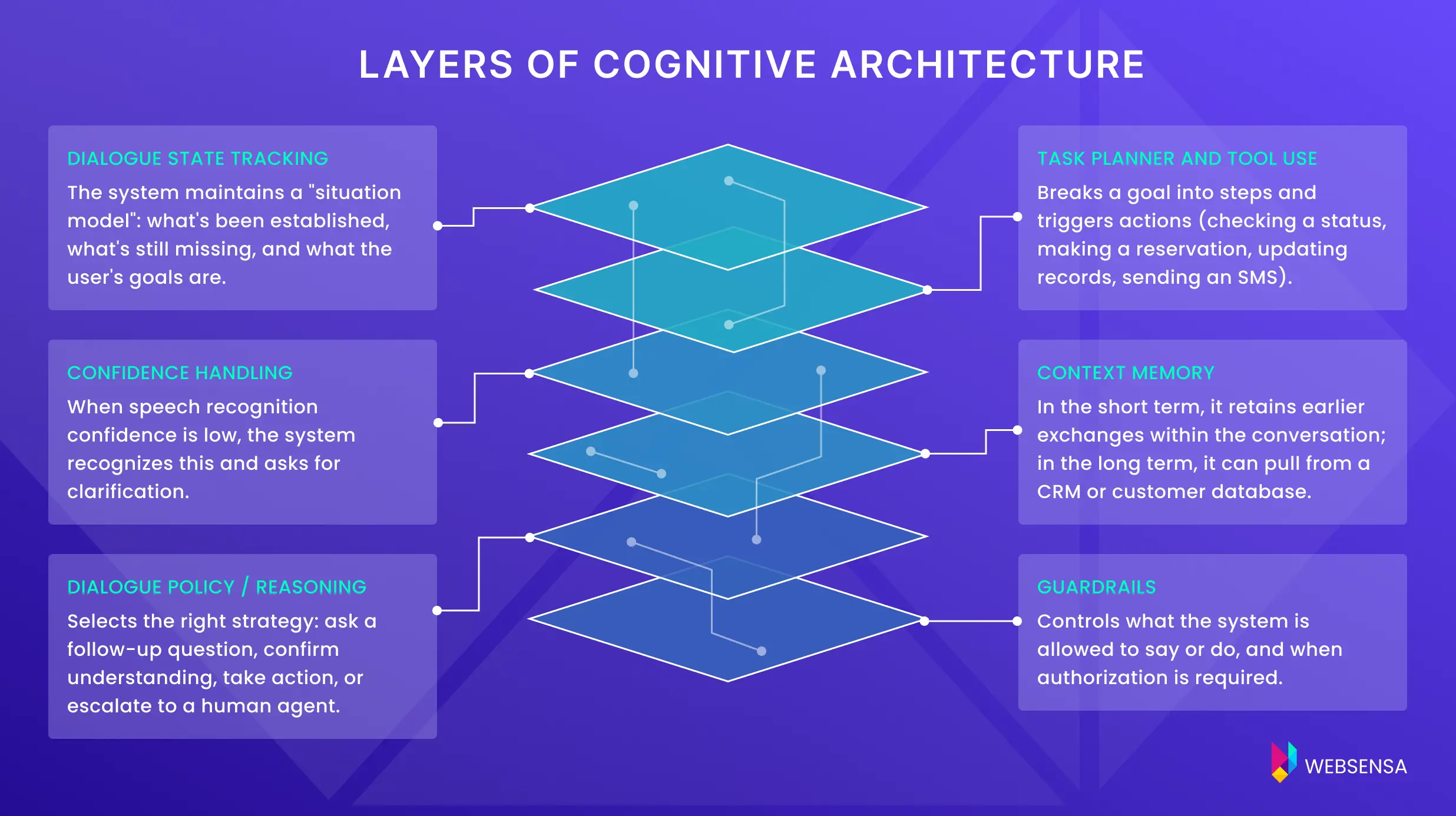
In practice, a cognitive architecture consists of several layers:
- Dialogue state tracking: the system maintains a "situation model": what's been established, what's still missing, and what the user's goals are.
- Context memory (short-term and long-term): in the short term, it retains earlier exchanges within the conversation; in the long term, it can pull from a CRM or customer database.
- Dialogue policy / reasoning layer: selects the right strategy: ask a follow-up question, confirm understanding, take action, or escalate to a human agent.
- Task planner and tool use: breaks a goal into steps and triggers actions (checking a status, making a reservation, updating records, sending an SMS).
- Confidence handling: when speech recognition confidence is low, the system recognizes this and asks for clarification.
- Guardrails: controls what the system is allowed to say or do, and when authorization is required.
The architecture defines a fixed set of processing mechanisms, while the system's actual behavior emerges from the current context, available knowledge, and conversational goal. This means the same system can handle very different scenarios without each one needing to be designed from scratch.
Architecture vs. model: an important distinction
The difference is that a model is responsible for a specific function (e.g., generating text, recognizing patterns), while the architecture defines things like:
- Which models are used
- When and in what order they're called
- How they exchange information with each other
- How the system responds to uncertainty
- What decisions it can make autonomously
The real challenge is bringing higher-level functions — planning, reasoning, and dialogue management — together into a coherent whole. Without a well-designed architecture, even the best model remains an isolated component.
In mature AI systems, it's the architecture that determines whether a solution performs reliably, predictably, and usefully in real-world conditions.
How does cognitive architecture differ from a traditional chatbot?
For any single response, both a traditional chatbot and a system built on cognitive architecture can produce a correct, reasonable answer.
The differences only become apparent over the course of an entire conversation, especially when:
- User doesn't state their goal explicitly
- They change their mind mid-interaction
- They provide incomplete or contradictory information
- They expect the system to figure out the next step on its own
In these situations, a traditional chatbot reacts to individual messages in isolation, while a system built on cognitive architecture interprets the conversation as a chain of connected decisions leading toward a specific goal.
How cognitive architecture changes the flow of a conversation
The differences between a traditional chatbot and a system built on cognitive architecture are best seen not in a single response, but in how the system manages a conversation from start to finish.
Example 1: The user doesn't state their goal upfront
The user opens with a vague statement, without a clearly defined goal.
A traditional chatbot:
- Tries to match the utterance to a single intent
- Asks questions disconnected from context
- Quickly loses track when the conversation doesn't fit a predefined scenario
A system with cognitive architecture:
- Builds a hypothesis about the conversational goal
- Only asks about the specific information that's missing
- Updates its assumptions as the conversation progresses
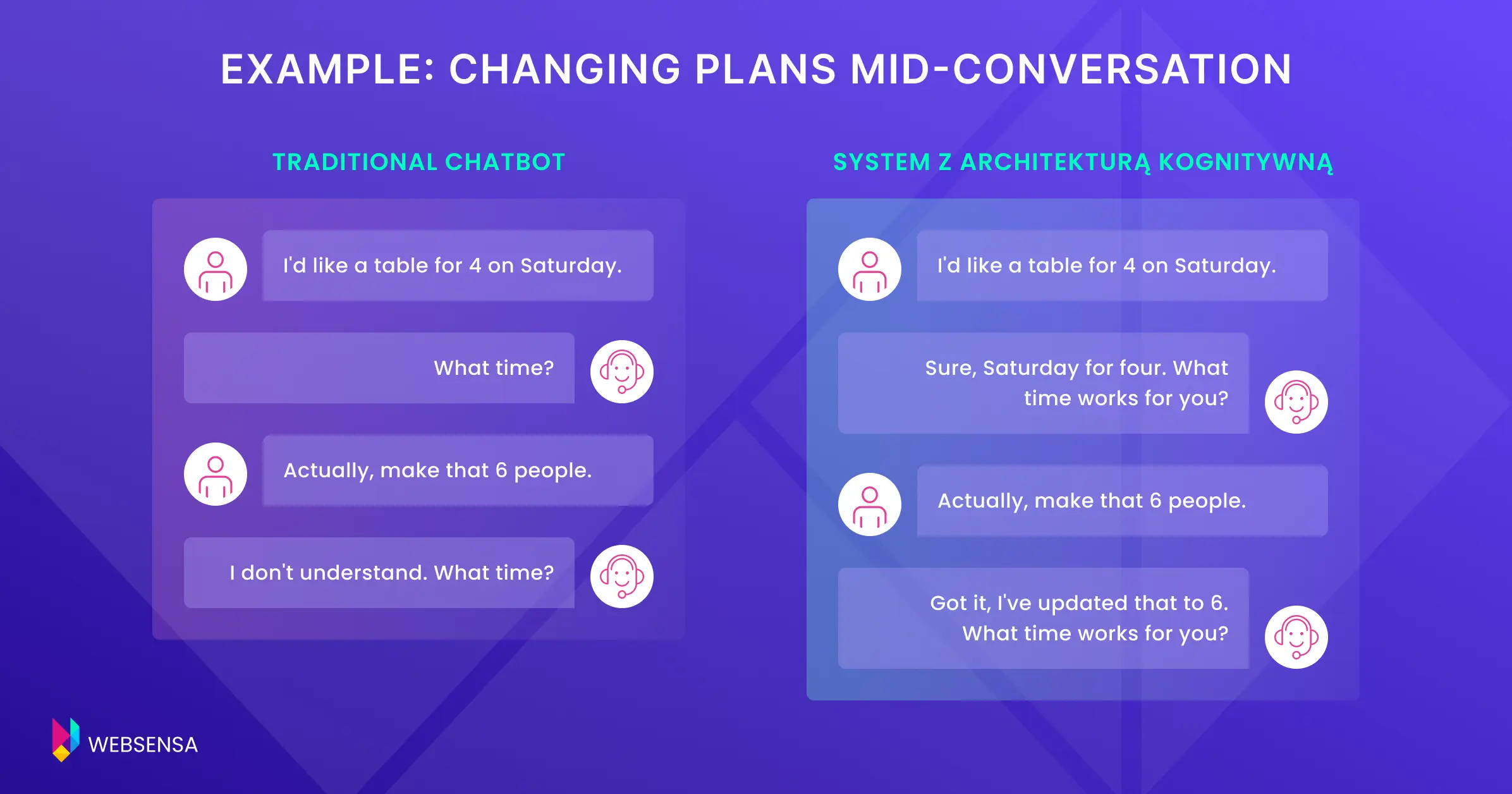
Example 2: The user changes their mind mid-conversation
Halfway through, the user changes their mind or revises something they said earlier.
A traditional chatbot:
- Tries to complete the original scenario
- Requires restarting the process or backtracking through the conversation
A system with cognitive architecture:
- Updates the conversational goal
- Reinterprets earlier information in light of the new context
- Seamlessly adjusts the next steps
Example 3: A voice conversation under time pressure
A short phone call where the user just wants to get things done as quickly as possible.
A traditional voicebot:
- Follows a rigid script
- Doesn't react to the caller's pace, hesitation, or frustration
A system with cognitive architecture:
- Shortens the dialogue when the user is decisive
- Simplifies questions when tension is high
- Drives the conversation toward a concrete action
In practice, this means a response time of under 0.5 seconds — within which the system has to process what was said, analyze tone and pace, update the conversation state, decide on the next step, and generate a response. The moment the caller finishes a sentence, they expect an immediate reaction.
Where is cognitive architecture used in practice?
Cognitive architecture is relevant to any conversational system where the conversation is meant to lead to a specific outcome, not just generate a response. This applies especially to:
- Website chatbots: Maintaining conversation context and guiding the user through a process instead of answering isolated, one-off questions. This turns a chatbot from an interactive FAQ into a logical interface for the services and information available on the site.
- Customer service voicebots: Essential in real-time conversations where speed, natural dialogue, and quick resolution matter. The system has to respond to shifts in tone, hesitation, and time pressure.
- AI-powered customer service platforms: Maintaining coherent actions across longer, more complex conversations, especially in solutions integrated with CRMs, ticketing systems, or booking engines. These are what determine whether a conversation actually triggers a business process.
- AI agents and autonomous systems: Defining the boundaries of what the system can decide on its own, planning next steps, and staying predictable even in complex scenarios.
In every one of these cases, it's not an individual model but the overall architecture that determines whether a conversational system performs effectively in real-world conditions.
Cognitive architecture in practice: a restaurant industry example
A solution deployed for the MojStolik.pl platform shows how cognitive architecture works in real-world conditions.
MojStolik.24 is a system for handling phone conversations with restaurant guests, built on a dual-brain architecture — two layers that process the conversation in parallel:
- The reactive layer operates in real time. It analyzes speech pace, pauses, hesitation, and shifts in tone. It responds instantly — when it detects tension in the caller's voice, it simplifies the dialogue. When the caller is decisive, it keeps follow-up questions to a minimum. When there's hesitation, it allows more time to think.
- The strategic layer oversees the big picture. It sets the conversational goals, checks whether things are heading in the right direction, verifies availability in the background, and manages data. It signals to the reactive layer when to move to specifics and when to give the caller space.
The system handles:
- Reservations outside opening hours and during peak times
- Special requirements such as table location and additional services
- Automatic SMS confirmations
- Over 30 languages
The project went from first conversations to a working solution in a matter of days. Not because "AI did everything," but because the architecture and the information flow between layers were clearly defined from the start.
Business benefits of cognitive architecture
Faster response times to customer inquiries
According to Zendesk data, a good benchmark for email response is within 12 hours, with 4 hours considered optimal. For social media, we're talking 5 or 2 hours, while live chat expectations are measured in seconds. Conversational systems designed with cognitive architecture can respond even faster than these benchmarks, without requiring the team to be involved in every interaction.
Higher service efficiency without growing the team
Data shows that over 60% of customer inquiries either go unanswered entirely or receive a significantly delayed response. Cognitive architecture makes it possible to automate simple, repetitive tasks without sacrificing conversation quality. This frees teams up to focus on cases that genuinely require human intervention.
Shorter conversations and lower operating costs
A system that understands the goal of a conversation and can decide on its own when to take action leads to shorter, more focused dialogues. This is especially important in voice conversations, where every extra minute carries a real cost.
Better user experience and lower risk of losing customers
As many as 89% of consumers say they would consider switching providers after a poor customer service experience. At the same time, negative experiences are shared more often than positive ones. The coherent, natural conversation that cognitive architecture enables significantly reduces the risk of frustration and abandoned interactions.
Scalability without sacrificing quality
A well-designed architecture allows you to handle a growing volume of conversations without costs scaling linearly. This is particularly valuable during high-traffic periods like sales seasons or peak customer service hours.
Want to implement cognitive architecture in your business?
The MojStolik case study illustrates that the effectiveness of conversational systems doesn't come down to the quality of individual AI models alone. What matters most is how the entire system is designed — its architecture, decision-making logic, and alignment with real business processes.
At WEBSENSA, we build solutions where AI is a tool that supports concrete actions: reducing handling times, taking pressure off teams, and improving user experience.
If you're wondering whether this approach makes sense for your situation — book a free AI diagnosis with our expert, who can help assess whether cognitive architecture can meaningfully support your system or business process.


